

.jpg)
On April 23 at Rhodes House, Oxford, the Atlantic Institute and Raintree Foundation convened Atlantic Fellows alongside other leaders, practitioners, researchers and community voices for Landscapes of Justice, a gathering focused on approaches to equitable landscape regeneration.
A key outcome of the convening is the development of the Oxford Statement on Equitable Landscape Regeneration — a framework intended to guide more equitable approaches to how landscapes are defined, governed and financed. The framework is designed to support funders, policymakers, practitioners, researchers, and communities working on landscape regeneration around the world.
Convening participants explored the relationships between ecology, power, knowledge, and stewardship through the lived realities of communities confronting challenges in transboundary river governance in India, as well as the daily flooding affecting islanders’ homes and businesses in the Philippines. Presentations by Atlantic Fellows Enamul Mazid Khan Siddique and Ana P. Santos grounded the discussions in the experiences of these communities, highlighting how systems of landscape governance can make some populations visible while marginalizing others. Enamul also called for restoration initiatives to be responsive to entrenched power inequalities, enduring historical injustices that shape current relations in these landscapes, and climate change as a defining reality of both the present moment and the future.
The Atlantic Institute is developing The Equity Review, a biennial open-access publication intended to contribute to global conversations on equity. The Review is guided by six core principles: equity in power; equity in knowledge, equity in resources; a vision for systems; community at the centre; and solutions that learn and scale.
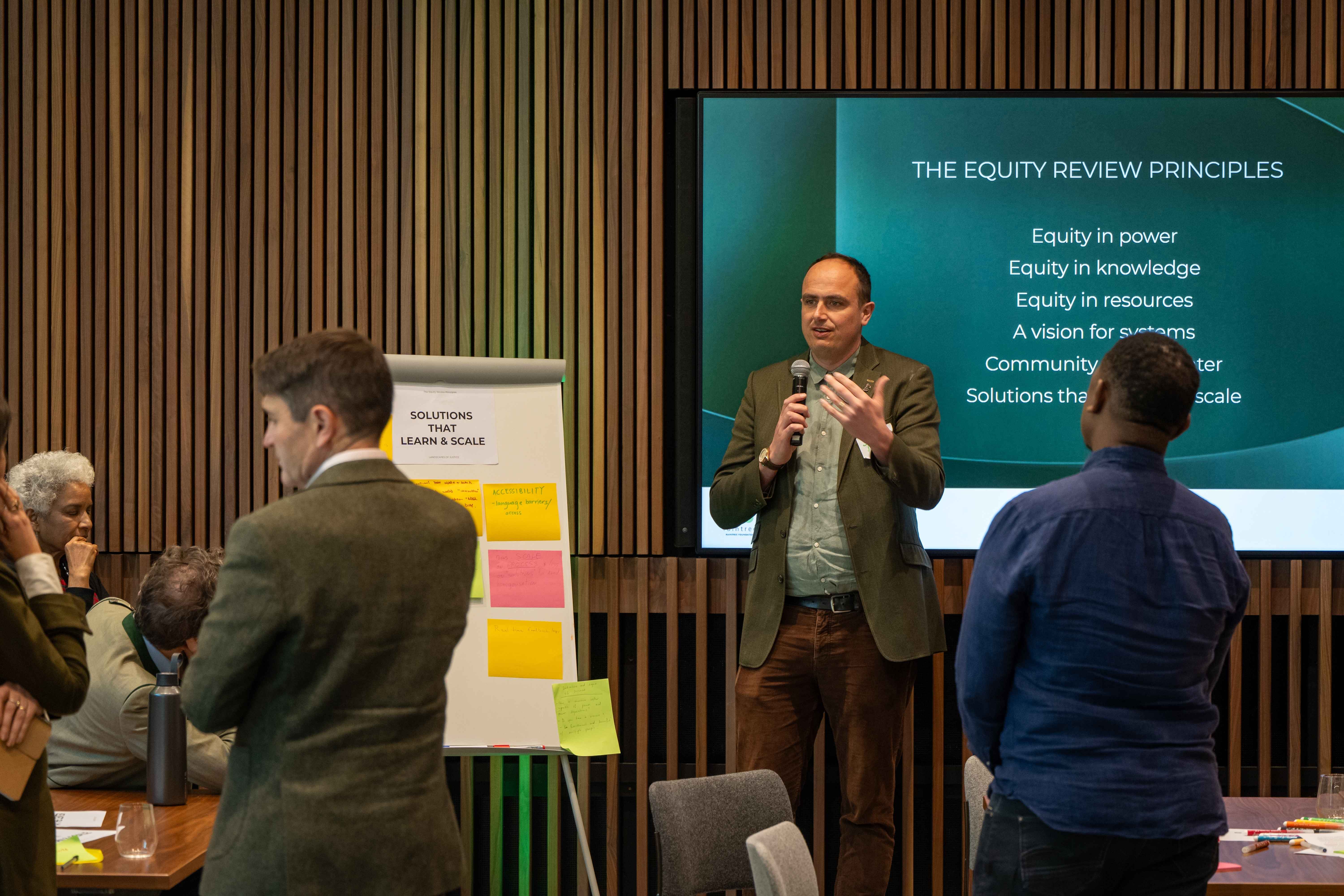
At the Landscapes of Justice convening, participants explored how these principles could be applied to equitable landscape regeneration through a facilitated workshop session. The resulting Oxford Statement on Equitable Landscape Regeneration adapts these principles into a practical framework for more equitable approaches to how landscapes are defined, governed, and financed.
Participants worked together to identify concrete interventions, behaviors and mechanisms that could help put these principles into practice. They included ensuring meaningful local community ownership and engagement with land regeneration projects, ensuring people most affected by inequity have a central role in shaping decisions and bringing together funders with complementary priorities and areas of focus.
Participants also examined potential indicators for measuring meaningful progress and accountability. In addition, they were invited to reflect critically on the framework itself and consider whether any important principles or perspectives might still be missing.
The Equity Review team is continuing to work with Atlantic Fellows and other convening participants to refine the principles tabled, discussed and debated during the convening. A final draft will be published later this year. Those interested in contributing to the ongoing work on the framework are invited to contact: equityreview@atlanticfellows.org.
About the author
Katherine Bond is responsible for the Global Partnerships strategy for the Institute and the community of Atlantic Fellows it supports. She believes passionately in the power of collaboration to drive social, economic and health innovation and brings extensive experience of working across international communities and multi-stakeholder environments. Prior to the Institute, Katherine was director of the Cultural Institute at King's College London, working at the interface between the university and the creative and cultural sectors; she has also held leadership roles within creative, policy, diplomacy and non-governmental organizations. Katherine began her career directing theater and music and continues to advocate for the arts as a platform for health and social change as a Fellow of the Royal Society of Arts.

.png)
